How to score a cricket match runs, extras, wickets and overs
Scoring is mostly counting, plus a handful of rules that trip up new scorers: what a wide does to the over, who gets the runs off a no-ball, and which wickets go to the bowler. This guide covers all of it, the way a club or tournament scorer needs it on match day.
The short version
- An over is six legal balls. Wides and no-balls are bowled again and do not count toward the six.
- Wides and no-balls cost the bowler a one-run penalty each. Byes and leg byes do not.
- The bowler gets the wicket for bowled, caught, LBW, stumped and hit wicket, but not for a run out.
- Strike changes after an odd number of runs and at the end of every over.
- Check your total at every over: batters' runs plus extras must equal the team score.
Before the first ball
Most scoring arguments start before the match. Settle these with both captains and the umpires at the toss, and write them down:
- Overs per side and how many overs each bowler may bowl.
- Players per side, and whether the last batter can bat alone.
- House rules on extras: whether a wide or no-ball is re-bowled (normal), and whether a no-ball gives a free hit.
- The batting order for both teams, or at least the openers, and who is keeping wicket.
- Who won the toss and chose to bat or bowl.
Local cricket bends the laws all the time, especially in box cricket and tennis-ball games. That is fine, as long as the scorer knows the house rules before the first ball.
Scoring each ball
For every delivery, a scorer records three things: what happened, who it counts for, and whether it was a legal ball. On a paper sheet that means a mark in the bowler's over, a mark against the batter, and the running total.
| What happened | Batter gets | Bowler charged | Counts in the over? |
|---|---|---|---|
| Dot ball | A ball faced | Nothing | Yes |
| Runs off the bat | The runs, and a ball faced | The runs | Yes |
| Four or six | 4 or 6, and a ball faced | 4 or 6 | Yes |
| Wide | Nothing | 1 plus any runs taken | No, bowl again |
| No-ball | Any runs off the bat, and a ball faced | 1 plus runs off the bat | No, bowl again |
| Bye or leg bye | A ball faced, no runs | Nothing | Yes |
Traditional scorebooks use a dot for a dot ball, the number for runs, and a small symbol for each kind of extra. The symbols vary between books, so pick one set and use it all match.
Extras: wides, no-balls, byes and leg byes
Extras are runs the batting team gets that no batter scored. They go in the extras column, and some of them also count against the bowler.
Wides
The umpire calls a wide when the ball is too far from the batter to hit with a normal shot. The batting side gets one run, the ball is bowled again, and the wide goes against the bowler. If the batters run or the wide goes to the boundary, every run is a wide: a wide that runs away for four is five wides.
No-balls
A no-ball is usually a front-foot overstep, a full toss above waist height, or a ball that bounces too many times. It adds a one-run penalty and is bowled again. Runs hit off the bat go to the batter and the bowler, and the batter is credited with a ball faced. Many limited-overs games give a free hit on the next ball, where the batter can only be out in a few ways, such as a run out.
Byes and leg byes
Byes are runs taken when the ball beats the bat, the batter and the keeper. Leg byes are runs taken after the ball hits the batter's body, as long as they were playing a shot or getting out of the way. Both are extras and neither counts against the bowler, so a bowler can bowl a maiden over that still gives away byes.
Umpires can also award five penalty runs, for example when the ball hits a fielding helmet left on the ground. They go in extras and are not charged to the bowler.
Wickets and who gets credit
Every dismissal adds a wicket to the team total. Only some go into the bowler's figures.
| Dismissal | Bowler's wicket? | Write down |
|---|---|---|
| Bowled | Yes | The bowler |
| Caught | Yes | The fielder and the bowler |
| LBW | Yes | The bowler |
| Stumped | Yes | The keeper and the bowler |
| Hit wicket | Yes | The bowler |
| Run out | No | The fielder or fielders, and which batter was out |
| Obstructing the field, timed out | No | The method |
| Retired | No | Retired hurt (can return) or retired out |
On a run out, check which batter was out: it is the one nearest the broken wicket, not always the striker. Also record whether the batters crossed, because that decides who faces the next ball.
Overs, strike and run rate
Who is on strike
The batters swap ends with every completed run. After 1, 3 or 5 runs the other batter faces the next ball; after 0, 2, 4 or 6 the same batter stays on strike. At the end of the over the bowling switches ends, so the strike flips once more. Most scoring mistakes on paper are a wrong striker, so check it after every ball.
Overs and maidens
An over is complete after six legal balls. Write overs as completed overs and balls, so 12.3 means twelve overs and three balls. A maiden is an over where the bowler concedes no runs; byes and leg byes do not spoil it, but a wide or no-ball does.
The numbers on a scorecard
| Number | How to work it out | Example |
|---|---|---|
| Run rate | Runs ÷ overs (part overs in sixths) | 75 in 10.3 overs: 75 ÷ 10.5 = 7.14 |
| Required run rate | Runs needed ÷ overs left | 48 needed off 6 overs: 8.00 |
| Batting strike rate | Runs ÷ balls faced × 100 | 30 off 20 balls: 150 |
| Economy | Runs conceded ÷ overs bowled | 28 off 4 overs: 7.00 |
| Batting average | Runs ÷ times out | 240 runs, 12 outs: 20.0 |
Not sure whether a strike rate of 130 is any good in your format? See what a good strike rate and economy look like in box cricket, short matches, T20 and one-day games.
Checks that catch mistakes
-
1
Every ball: who is on strike
Look up and confirm the striker before marking the next ball. A wrong striker puts every later run against the wrong batter.
-
2
Every over: the totals agree
Batters' runs plus extras must equal the team score, and the bowlers' runs plus byes, leg byes and penalty runs must equal it too.
-
3
Every wicket: confirm with the umpire
Signal back to the umpire, then note the method, the fielder and which batter is out before the next ball.
-
4
At the break: match the other scorer
If both teams keep a book, compare score, wickets and overs at the innings break and settle any difference then, not after the match.
Scoring on a phone instead of paper
Plenty of village and club scorers still use a paper book, and it works. A scoring app follows the same rules but does the counting for you, which removes the most common mistakes.
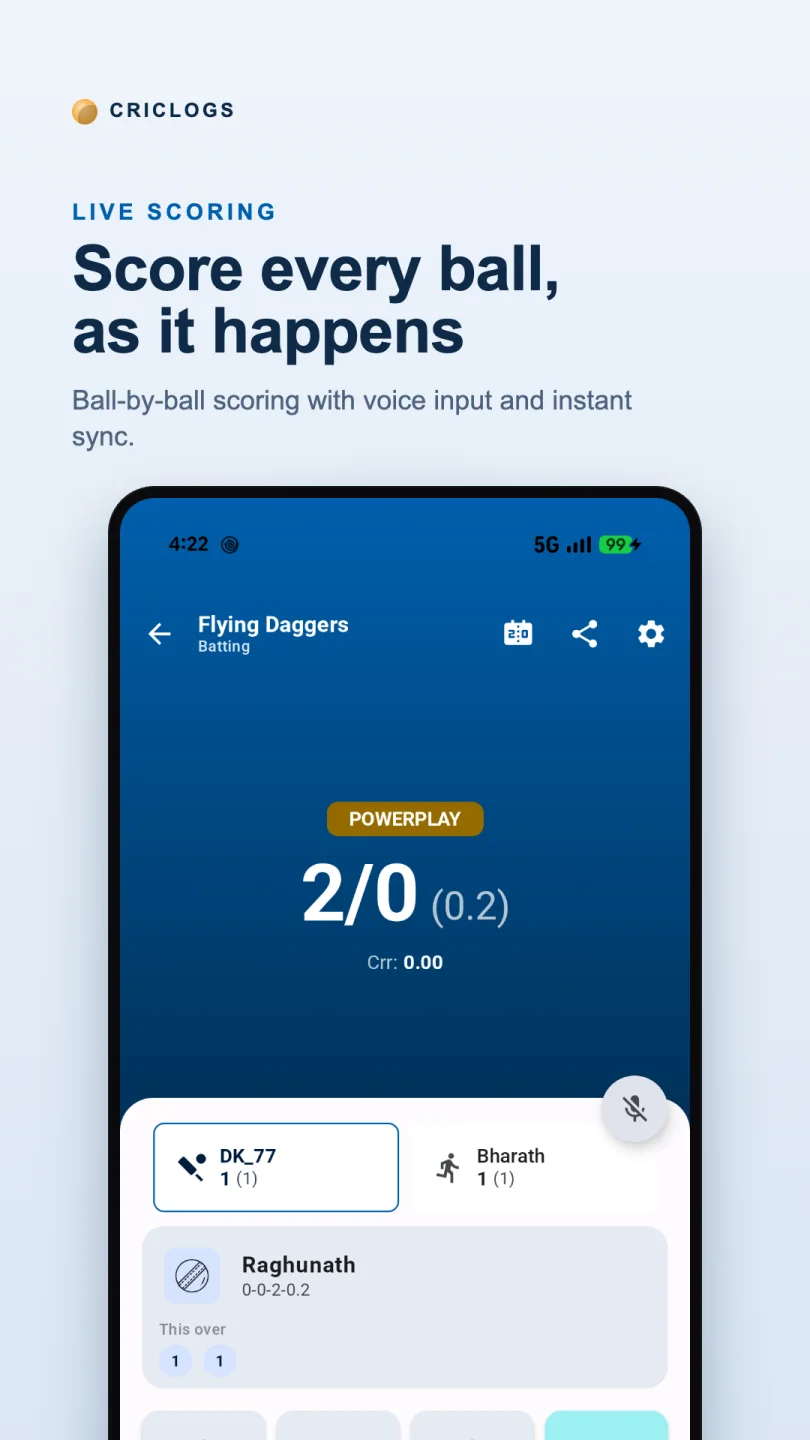
- The strike and the over count are automatic, including re-bowled wides and no-balls.
- Extras are split correctly between the bowler's figures and the extras column.
- The totals always agree, so the end-of-over check is done for you.
- Supporters follow a live scorecard from a link, instead of messaging the scorer.
- Player stats build themselves from every match you score.
CricLogs Cricket Scorer is free on Android with no ads, and it keeps scoring with no internet at grounds without signal.
Frequently asked questions
Does a wide count as a ball in the over?
Who gets the runs off a no-ball?
What is the difference between byes and leg byes?
Which wickets does the bowler get credit for?
How do you work out run rate?
Do I still need a paper scorebook?
Let the app do the counting
CricLogs is free on Android with no ads. Score each ball with a tap and share a live scorecard with everyone at the ground.
Download free on Google Play